Showing posts with label Zambia. Show all posts

Tuesday, August 6, 2013

Gemfields Kagem Emerald Mine Showed Solid Annual Growth Despite Conflict With Zambian Government

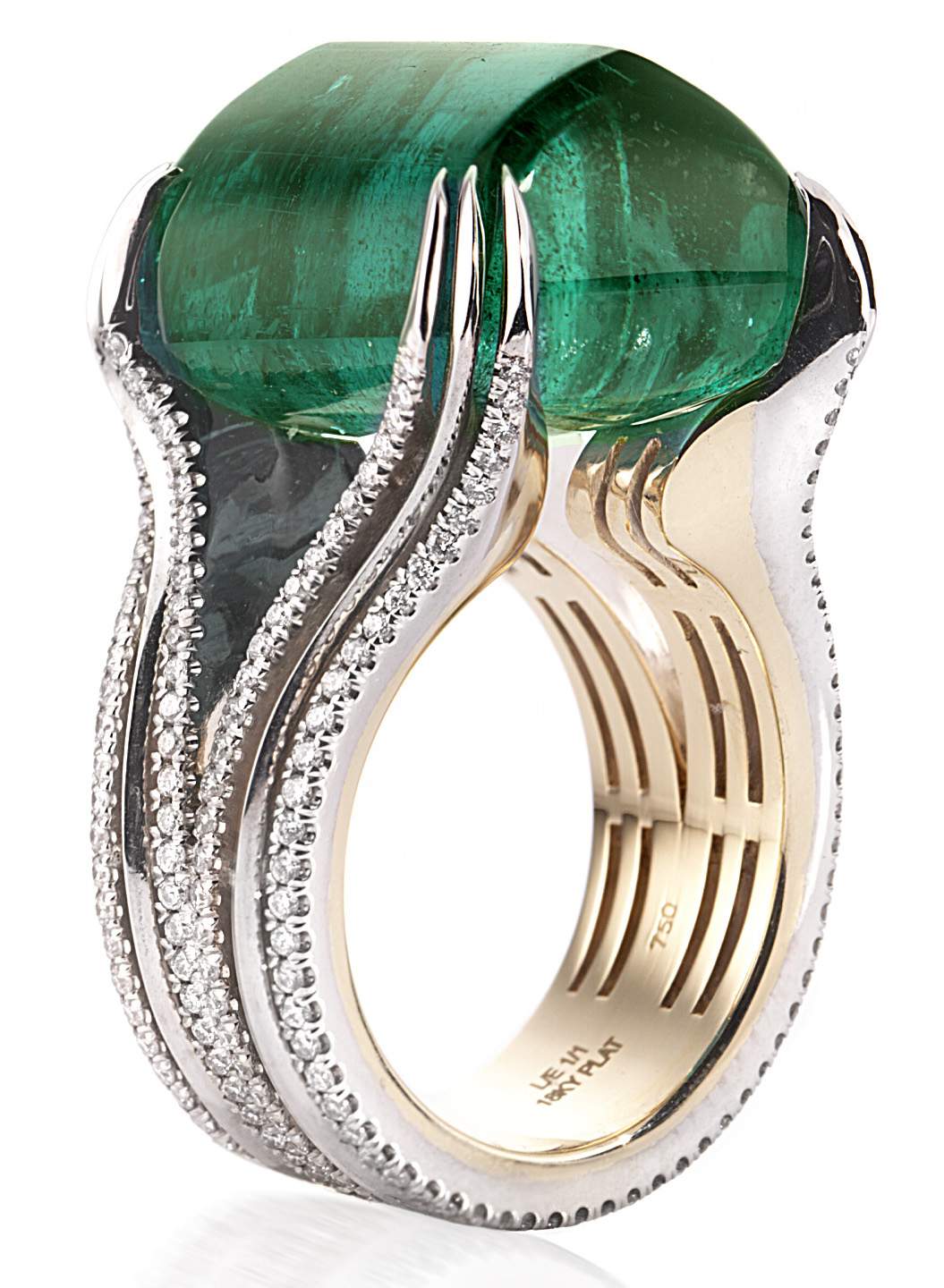
Coomi 20K yellow gold with Gemfields’ Zambian emeralds, 120.34 carats and diamonds, 5.21 carats.

Production at the Gemfields Kagem emerald mine in Zambia increased 42 percent to 29.99 million carats for the 12-month period ended in June.

The average grade for the year increased 38 percent to 283 carats per ton, the company said Monday through the Proactive Investors website. Meanwhile, production costs fell 26 percent in the year.

Gemfields is a colored gemstone exploration, mining and marketing company. The Kagem mine is the London-listed company’s biggest asset and it provides nearly all of its revenue, even though it has interest in other colored gemstone mines. It owns a 75-percent share of the Kagem mine with the Zambian government owning the remaining 25 percent.

One of Gemfields other mines is the Montepuez ruby deposit in Mozambique. The company said it is on track to hold its first auction of rough rubies in the first quarter of 2014.

Gemfields also owns Fabergé, which it fully acquired in January. The company said the luxury jewelry brand achieved a record number of unit sales for the year.

A sale of lower quality emeralds in April netted $15.2 million, Gemfields said. Not included in the annual results was its latest auction of higher quality emeralds, held in the Zambian capital of Lusaka. This brought in revenues of $31.5 million, the second highest total ever for an auction of its kind.

The auction was originally scheduled in June in Singapore but pressure from the Zambian government to move the auction to Zambia caused the auction to be postponed until July, after the reporting period. Where to hold auctions has been a source of debate since April when the government of Zambia, Gemfields business partner, issued a directive for Gemfields to hold its auction within the country’s borders, citing capital flight.

Ian Harebottle, Gemfields CEO, said through Proactive Investors that communication between the two parties is now “much, much better” and more interactive.

However, Harebottle said the company continues “to seek guidance and to interact with the Government of Zambia.” Gemfields argues that it needs to sell Kagem emeralds at places that will likely get the most interest and the best price.

“While the two auctions held in Lusaka this year have certainly been successful, the key question, of course, remains what they would have generated had they been held abroad (where competing and undermining sources of supply, frequently illegal, are not readily available to our customers) and their potential impact on the long term growth of this sector,” he said.


Please join me on the Jewelry News Network Facebook Page, on Twitter @JewelryNewsNet and on the Forbes Web site.

Tuesday, July 23, 2013

Gemfields Emerald Auction in Zambia Raises $31.5 Million

Gemfields spokesperson Mila Kunis.

Maybe holding emerald auctions in Zambia isn’t such a bad idea. The ongoing tug of war between the Zambian government and colored gemstone mining and marketing company, Gemfields, over where to sell Zambian emeralds hasn’t dampened demand.

Gemfields’ most recent auction of higher quality rough emerald and beryl from the Kagem mine in Zambia resulted in revenues of $31.5 million, the second highest total to date for the company. The average price per carat reached $54, the highest unit value achieved at any auction and a 26 percent increase over the previous highest value achieved in July 2011. In addition, a 54-carat rough gem, offered as a single lot, set a new per carat record for prices achieved at a Gemfields auction.

A total of 40 companies were invited to the auction held July 15 - 19 in the Zambian capital city of Lusaka and 37 attended, with 36 attendees placing at least one bid, Gemfields said in a statement Tuesday. A total of 583,448 carats of emerald extracted from Kagem was placed on offer, with all lots being sold. The auction format is how Gemfields chooses to sell its Kagem emeralds, which account for nearly all of the company’s revenue.

The auction was held in Lusaka at the request of the Zambian Ministry of Mines, Energy and Water Development. The government first issued the directive in April, which appeared to be a surprise to Gemfields. Particularly since the two entities are business partners, with Zambia owns a 25 percent stake in the Kagem mine with Gemfields owning the remaining 25 percent.

The government in a statement said the directive is designed to promote transparency and accountability in the marketing of emeralds, stimulate local demand for emeralds, create more opportunities for small-scale miners to have access to colored gemstone markets, and increase tourism.

“Zambian gemstones have for a long time been sold on foreign markets, a situation that has contributed to capital flight and denied Zambians of the much needed benefits from the resource,” Yamfwa Mukanga, Zambia mining minister, said in the original statement.

This is the second auction of Kagem emeralds held in Lusaka. It was originally scheduled to be held in Singapore June 10-14, but was postponed and rescheduled to Lusaka due to government pressure.

Gemfields insists that it needs to sell Kagem emeralds at places that will likely get the most interest and the best price in order to compete with other emerald hubs, such as Colombia and Brazil. With the most recent sale showing such strong results the government seems to have the upper hand in this argument.

In a statement, Ian Harebottle, CEO of Gemfields, credited “favorable market conditions and particularly strong demand from our customers” for the strong results. “All indications show that demand for colored gemstones, and especially emeralds, will continue to increase at a steady pace over the coming year.”

Gemfields said its 13 auctions held since July 2009 have generated $207.3 million in aggregate revenues.


Please join me on the Jewelry News Network Facebook Page, on Twitter @JewelryNewsNet and on the Forbes Web site.

Sunday, July 7, 2013

Pressure From Zambia Forces Gemfields to Reschedule Emerald Auction

A Gemfields advertisement for its Kagem emeralds from a recent marketing campaign.

Gemfields has rescheduled its auction of emeralds from the Kagem mine in Zambia due to Zambian officials’ insistence that the company hold its auctions within the country’s borders.

The London-based colored gemstone exploration, mining and marketing company planned to auction higher grade rough emeralds in Singapore from June 10-14, but a change of policy on the part of the Zambian authorities caused the company to postpone the sale, it said through the Proactive Investors website on July 1. The auction will now take place July 15-19 in Lusaka, the capital city of Zambia.

The date change will affect Gemfields financial reporting for the fiscal year, which ended June 30. The delay means the company only completed two auctions during the fiscal year that generated $42 million in revenue, compared with four auctions held during the prior fiscal year that generated $77.9 million.

The directive was issued in April in the form of a written request by the Zambian Ministry of Mines, Energy and Water Development. Despite ongoing discussions, the country’s position apparently hasn’t changed. Even though Gemfields said Zambian officials have insisted there is no ban on overseas auctions.

The government of the Republic of Zambia owns 25 percent of the Kagem mine while Gemfields owns the remaining 75 percent. In addition, the two parties own a 50-50 stake in the Kariba amethyst mine, which will also be affected by the outside selling ban. However, nearly all of Gemfields income comes from the Kagem mine.

What’s at issue is the government’s belief that it isn’t receiving enough of the economic benefits from the mine.

“Zambian gemstones have for a long time been sold on foreign markets, a situation that has contributed to capital flight and denied Zambians of the much needed benefits from the resource,” Yamfwa Mukanga, Zambia mining minister, said in its written request issued in April.

For its part, Gemfields insists that it needs to sell Kagem emeralds at places that will likely get the most interest and the best price in order to compete with other emerald hubs, such as Colombia and Brazil.

Since 2007, Gemfields has been creating a mine-to-market initiative for its emeralds using the Kagem mine as a single, traceable source for its emeralds. In addition, it is working on a program to mine its emeralds in adherence to fair-trade practices and in accordance with environmental, social and safety standards. The distribution of its emeralds includes the Faberge luxury jewelry brand, which it owns. 

Please join me on the Jewelry News Network Facebook Page, on Twitter @JewelryNewsNet and on the Forbes Web site.

Wednesday, April 10, 2013

Zambia Restriction on Gem Sales A Major Setback for Gemfields

Mila Kunis in a Gemfields ad.

The Zambia Ministry of Mines, Energy and Water Development issued a directive Friday stating that all auctioning of emeralds be held in Zambia, arguing that their sale in foreign markets contributes to capital flight. The timing of this order has dealt a major blow to the emerald ambitions of Gemfields, which operates what is believed to be the world’s largest emerald mine in Zambia.

The government in a statement said the directive is designed to promote transparency and accountability in the marketing of emeralds, stimulate local demand for emeralds, create more opportunities for small-scale miners to have access to colored gemstone markets, and increase tourism.

“Zambian gemstones have for a long time been sold on foreign markets, a situation that has contributed to capital flight and denied Zambians of the much needed benefits from the resource,” Yamfwa Mukanga, Zambia mining minister, said in the statement.

The move seemed to have come as a surprise to the London-listed company and the markets. Gemfields shares fell 16 percent Monday after the government announcement. In the past, Gemfields held its emerald auctions in other locations, including Singapore and in Jaipur, India. The next auction of its emeralds was already planned to be held in Zambia’s capital city of Lusaka from April 15 - 19.

The company is in partnership with the country of Zambia, which makes this seemingly sudden announcement more difficult to understand. Gemfields owns a 75 percent stake in the Kagem emerald mine with the government owning the remaining 25 percent. In addition, the two parties own a 50-50 stake in the Kariba amethyst mine, which will also be affected by the outside selling ban.

“Not allowing Gemfields to auction abroad is going to take us out of the competition with Brazil and Colombia, which holds 30 percent each of the world's supply of emeralds,” Dev Shetty, Gemfields COO, told Reuters.

The company that wants to do for emeralds what De Beers did for diamonds in the 20th Century recently had a string of marketing successes. It signed actress Mila Kunis as its ambassador; released an emerald-specific colored gemstone jewelry line made by independent jewelry designers ranging from Theo Fennell and Stephen Webster, Shaun Leane and Alexandra Mor; and finalized the acquisition of luxury jeweler Fabergé.

Since 2007, Gemfields has been creating a mine-to-market initiative for its emeralds using the Kagem mine as a single, traceable source for its emeralds. In addition, it is working on a program to mine its emeralds in adherence to fair-trade practices and in accordance with environmental, social and safety standards.


Please join me on the Jewelry News Network Facebook Page, on Twitter @JewelryNewsNet and on the Forbes Web site.

Wednesday, February 20, 2013

Mila Kunis Featured in Global Advertising Campaign for Gemfields


Mila Kunis, recently named “Sexiest Woman Alive,” by Esquire, is the newest ambassador and the face of the latest advertising campaign for colored gemstone producer, Gemfields.

In a statement Gemfields said that Kunis was chosen “for her natural beauty, versatility, intelligence and love of rare colored gems.”

Gemfields primary business is the mining, distribution and marketing of emeralds from the Kagem mine in Zambia. It is working to produce a mine-to-market strategy for their emeralds that it says will be ethical, transparent and sustainable. The company recently acquired Fabergé, and is supplying the luxury brand with Kagem emeralds for its newest creations. Both companies are controlled by Pallinghurst Resources, a private equity company focused on the mining sector.

The advertising campaign with Kunis is photographed by Mario Sorrenti and styled by Anastasia Barbieri, featuring “a fresh-faced and modern Kunis wearing one-of-a-kind emerald and ruby jewelry created by six of Gemfields’ designer partners: Alexandra Mor, Amrapali, Dominic Jones, The Gem Palace, Sutra and Fabergé.”

Kunis toured Kagem, accompanied by Ian Harebottle, Gemfields CEO, and visited several Gemfields-sponsored community projects, including schools and a farming cooperative.

“While in Africa, I learned that the entire journey that each Gemfields stone takes is carefully considered and that the environment and the local communities where its mines are located are held in the highest regard,” said Kunis.

“Mila has blown me away with her energy, enthusiasm and dedication,” Harebottle said.

The global advertising program is running in leading publications in India and is part of a several initiatives in a multi-pronged consumer campaign that Gemfields will roll out this year.

The Kagem mine also produces amethysts. Gemfields other business include a mine in Mozambique for rubies, and prospecting licenses for other gemstones in Madagascar.


Please join me on the Jewelry News Network Facebook Page, on Twitter @JewelryNewsNet and on the Forbes Web site.
Thursday, October 11, 2012

Gemfields Revenue and Profit Soar

Miners hold a rough emerald from the Kagem mine in Zambia.

Colored gemstone mining and marketing company, Gemfields, reported that revenue from sales increased 108 percent to $83.7 million, year-over-year, for the year ended June 20. Pre-tax profit for the same period increased 140 percent to $47.8 million.

“They certainly are great numbers,” said Ian Harebottle, CEO of the London (AIM)-listed company, which specializes in emeralds from the Kagem mine in Zambia.

Harebottle, speaking in a video from ProactiveInvestors, said the company spent the first six months of the year focusing on waste removal on the Kagem mine, the company's largest asset and one of the world's major sources of emeralds, in order to expand production at the mine. The last six months of the year was focused on emerald production.

“We had pleasing results but our decision to remove waste and look for long term is paying off,” he said.

The company also has been working hard in diversifying its product base. It owns a 75 percent stake in the Montepuez ruby mine in Mozambique. The company also owns the Kariba amethyst mine in Zambia that it plans to continue to invest in.


Alexandra Mor ring with Gemfields' emerald.

In addition to its mines, the company has been involved in an international advertising campaign focusing on Zambian emeralds and, last month, launched its emerald-focused campaign in the U.S. by having a number of jewelry designers make pieces with its Zambian emeralds.

The company’s cash balance nearly tripled to $36.7 million. Harebottle said that money will not be used for stock dividends but instead will be invested in the growth and diversification plans of the company.

“I believe right now if we could use it within the business, we’ll put it to much better use in terms of shareholder return,” he said.

Below is a video of Harebottle's interview with ProactiveInvestors:

Please join me on the Jewelry News Network Facebook Page and on Twitter @JewelryNewsNet.

Tuesday, August 2, 2011

Gemfields Kagem Mine Posts Stong Gains

Miners at the Kagem emerald mine in Zambia. Photo credit: Gemfields

Mining company Gemfields has reported record annual production from its emerald mine in Zambia with a jump in grades per ton and a cut in production costs.

In an operational update for its fourth quarter and full year to June 2011, the company says annual production increased 90 percent to 33 million carats versus the previous year, as reported by the Proactiveinvestors financial news service. Gemfield's 75 percent owned Kagem mine in Zambia—the single largest emerald mine in the world. It is currently the company’s only operating emerald mine. The mine debt free, the company said.

Grade for the year came in at 478 carats per ton versus 286 in prior year, and per carat production costs were reduced by 41 percent to 43 cents per carat, according to the report. Rock handling costs for the year fell 25 percent to $3.70 per ton.

The final quarter of the year alone produced 10.8 million carats at a grade of 500 carats per ton and a unit cost of 32 cents per carat.

At its recent July auction of high quality rough emeralds, the company placed 1.07 million carats and successfully sold 740,000 carats to generate record sales of $31.6 million. Per carat prices at the July 2011 sale improved by 63 percent to 42.71 per carat, compared with its December 2010 auction.

So far, the company said it has completed seven auctions in the past two years, generating total revenue of $87.5 million.

Wednesday, March 30, 2011

Gemfields Emerald Auction Fetches $9.9 Million


Prices for lower-quality rough emeralds nearly tripled during the past year, according to Gemfields Plc., which recently held an auction of the precious gem from its Kagem mine in Zambia.

The mining giant’s auction of low quality emeralds from its wholly owned on March 10-14 in Jaipur, India, (where it owns a cutting and polishing facility) took in 77 cents per carat, a 148 percent increase from 31 cents per carat received in a similar auction in March 2010.

“This provides a clear indication of robust growth in both prices and demand for emeralds in general, and Gemfields’ ethical emeralds in particular, across all regions and all sectors,” the company said in a statement.

Of the 48 companies invited to attend the auction, 44 placed bids for the material on offer, Gemfields said. The auction saw 16.83 million carats placed on offer, with 12.98 million carats being sold, generating record lower quality auction sales of $9.9 million.

The three auctions held in the current financial year yielded $37 million in aggregate revenues, while all six auctions held since July 2009 have generated $55.7 million in combined revenue for Gemfields.

London-based Gemfields is the only mining company in the world that has incorporated a mine-to-market strategy for the emerald industry. Under the plan, emeralds would come from a single source (the Kagem mine) so the origin of each stone can be traced from the mine to the retail jeweler. In addition, the company is trying to produce emeralds in a way that adheres to fair-trade practices and in accordance with environmental, social and safety standards.

“Gemfields is naturally very pleased with the results in Jaipur,” said Ian Harebottle, Gemfields chief executive . “The overwhelming interest in attending Gemfields' auctions provides sound evidence of an increase in demand for our products across all grades and all markets.”

The Jaipur auction was also used as a platform to test the levels of demand for rough amethyst derived from Gemfields' 50 percent owned Kariba amethyst mine in Zambia. Gemfields said the results were encouraging and it expects to sell significant quantities of the gem.

Gemfields' next auction of predominantly higher quality rough emeralds is scheduled for July 2011.

The last of these, held in Johannesburg in early December 2010, achieved revenue of $19.6 million, exceeding the $18.7 million generated from the three previous emerald auctions held during the current 2009/10 financial year.